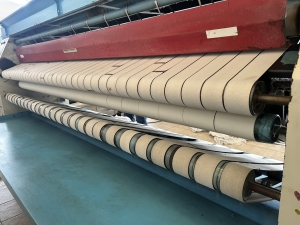
| In a commercial laundry operation, few things are as frustrating as a misaligned ironer belt. Whether you are commissioning a brand-new flatwork ironer or maintaining a seasoned workhorse, ironer belts tracking issues can lead to uneven drying, fabric damage, and costly downtime. In this guide, we break down how to diagnose and fix belt tracking problems for both new installations and daily operations. |
|
 |
Part 1: Commissioning a New Ironer – Getting It Right from Day One
Tracking issues on a new machine are usually related to installation precision rather than wear and tear.
1. Check for Level and Squareness
Before adjusting any bolts, ensure the machine frame is perfectly level. If the frame is twisted or slanted, the belts will naturally slide toward the lower side.
2. Verify Roller Parallelism
Ensure all drive and tension rollers are perfectly parallel to each other. Even a 1mm deviation across the width of the machine can cause a belt to drift.
3. The "Small Steps" Rule
When adjusting tension bolts on a new machine, use increments of
1/4 to 1/2 turn. Run the machine for
3 to 5 full cycles after every adjustment to let the belt find its new equilibrium. Never over-adjust in a hurry.
4. Heat Conditioning
New belts are often stiff. Run the ironer at operating temperature for 30–60 minutes. The heat will soften the fibers, allowing the belts to settle onto the rollers naturally.
Part 2: Troubleshooting Existing Machines – When Sudden Drift Occurs
If an ironer that has been running fine suddenly starts throwing belts, the cause is usually physical rather than a loss of adjustment.
1. The "False Crown" Effect (Debris Buildup)
This is the #1 cause of sudden tracking issues. Check for wax buildup, lint, or adhesive residue on the rollers. Even a small bump on the roller increases its diameter locally, "pushing" the belt out of alignment.
Action: Clean your rollers thoroughly.
2. Inspect the Lacing (Joiners)
Over time, belt lacing can wear or break on one side. If the joiner is no longer square to the belt edge, the belt will "dog-track" diagonally.
Action: Inspect and re-lace if necessary.
3. Component Failure
A sudden shift often points to a collapsed bearing or a failed tensioning spring. If the roller tilts because a bearing has seized, the belt tracking will fail instantly.
4. Consistent Feeding Habits
Ensure operators are feeding linens across the full width of the ironer. Constant feeding on only one side causes uneven friction and localized heat, leading to tracking drift.
Part 3: Golden Rules of Belt Tracking
- Track toward the tight side: In most tension-based systems, the belt moves toward the side with higher tension.
- Cleanliness is key: A clean roller is a true roller.
- Don't over-tension: Over-tightening belts leads to premature bearing failure and belt stretching. Use the minimum tension required to prevent slipping.
Conclusion
Maintaining perfect belt tracking is a mix of precise mechanical alignment and diligent cleaning. By following a systematic approach—checking for levelness first, cleaning rollers second, and making micro-adjustments last—you can ensure your laundry operation stays smooth and efficient.
New Section: Solving "Stray" Belts (When Only a Few Belts Misbehave)
Sometimes, the machine as a whole is fine, but one or two specific belts refuse to stay in line. This requires a more surgical approach:
1.The "Swap Test"
If a single belt keeps drifting, try swapping its position with a "healthy" belt from the center.
If the problem follows the belt: The belt itself is stretched or the lacing (joiner) was installed crookedly.
If the problem stays at the same position: There is a localized issue with a belt hook, a tensioning spring, or a specific spot on the roller. |
|
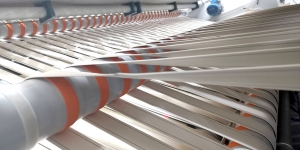 |
- Check for Individual Tension Balance
On many modern ironers, each belt has its own independent tensioning spring or weight. Ensure that the tension on the "stray" belt matches the others. A loose belt is a wandering belt.
- Inspect the Lacing Squareness
A belt will always track perpendicular to its lacing. If the metal staples or lace were applied even at a 1-degree angle, that belt will constantly try to climb to one side. If you see a "dog-leg" motion every time the joiner passes the roller, it’s time to re-cut and re-lace that specific belt.
- Localized Roller Cleaning
Check the specific area of the roller where the problematic belt sits. Often, a small piece of melted plastic or a buildup of ironing wax in that localized zone creates a "high spot" that deflects only the belts passing over it.
Conclusion:
Beyond mechanical adjustments, the good quality of the Ironer Belting is the most critical factor. A high quality belt is defined by its dimensional stability and perfectly square edges. Low-grade belts often suffer from uneven stretching (camber) or inconsistent density, making them physically impossible to track straight, regardless of machine adjustments. By investing in high-performance, heat-stabilized materials, you don’t just fix a tracking issue—you eliminate the root cause of friction, uneven wear, and costly downtime.
Hongkong XinYun Industrial Felting here offering kinds of high quality of ironer belting :
Laundry Ironer Belts & Felt Padding
*Chest ironer padding / felts
*Ironer belts / ribbons
*Guide tapes
*Folding cotton belts
*Gripper belt ( rough top rubber, pvc)
*Clippers / locks
*Ironer wax,wax cloth
*Steel wool pad (Steel fiber felt mat)
...